
Your Taylor Isn't the Problem.
Hear more of the guitar you already love when you plug in.
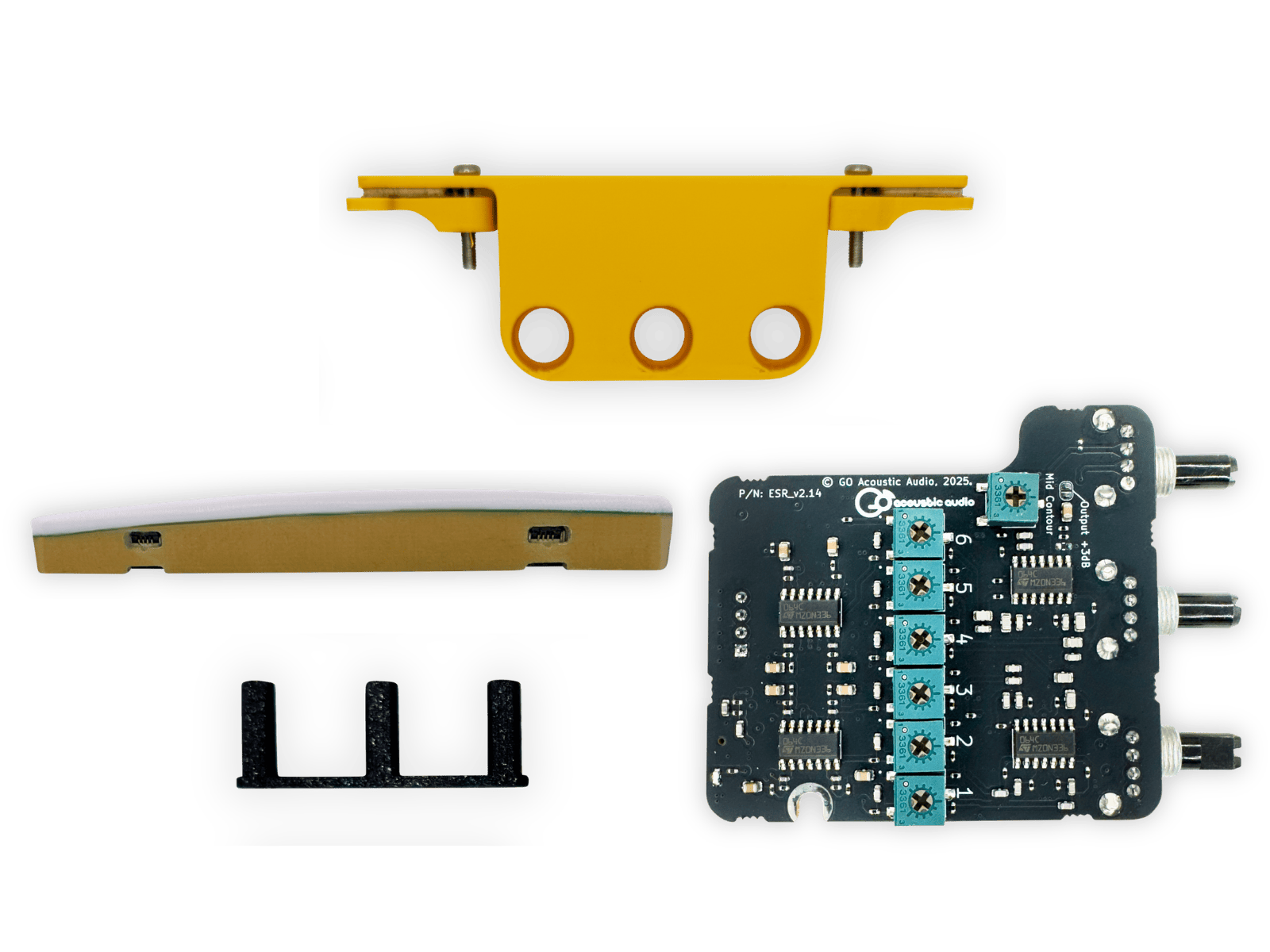
The ES Replacement System for Taylor ES1 and ES2 guitars replaces the factory electronics with a complete Saddle-Pickup and preamp system for warm, balanced amplified tone and high feedback resistance—while preserving the familiar control layout.
$425 --complete system
4.95 out of 5 Stars
Guided DIY installation
30-day money-back guarantee
Hear the Difference
Producer Bear Davis compares the factory Taylor ES electronics with the Go Acoustic Audio ES Replacement System. Listen for differences in attack, body, string balance, note separation, and overall natural character.
Love Your Taylor. Hear More of It When You Plug In.
You chose your Taylor for the way it feels, responds, and sounds in the room. The problem begins when the guitar reaches an amplifier, mixer, or PA and that character is replaced by a thin attack, brittle “quack,” uneven strings, excessive finger noise, weak output, or a signal that becomes difficult at performance volume.
Many Taylor owners in the customer reviews followed the same path: adjust the pickup, change strings, add EQ, compression, a DI, an impulse-response processor, or another pickup—and still feel that the amplified guitar does not sound like the instrument they bought.
The Guitar You Chose
Warm. Responsive. Detailed. Comfortable under your hands. A guitar whose acoustic voice makes you want to keep playing.
The Sound You Keep Fighting
Harsh attack. Thin body. Uneven string response. Too much handling noise. Not enough output. Feedback that makes the guitar—or the venue—feel unpredictable.
The real cost is not one disappointing electronic component. It is leaving a guitar you love at home, using another instrument onstage, buying more corrective gear, or considering selling the Taylor because its live sound is holding you back.
Some Taylor owners are satisfied with the factory system. If you already love your plugged-in sound, there is no reason to replace it. This system is for players who have adjusted, processed, and worked around the original electronics but still do not hear the guitar they want.
Built for the Stage
“I wrestled with the ES2 for years. Go Acoustic Audio transformed my K24ce into my favorite live instrument. It’s balanced, warm, and feedback-resistant.”
Glenn Phillips — Toad the Wet Sprocket • Taylor K24ce
A live guitar has to do more than sound good in a quiet room. It has to remain balanced, warm, responsive, and controllable when the stage gets louder. That is the performance problem the ES Replacement System is designed to solve.
Why Taylor Owners Replace the Expression System
Your Taylor is not the problem. If the pickup sends out a thin, harsh, or uneven signal, more processing later in the chain cannot fully correct it. The ES Replacement System fixes the problem at the source—before the sound reaches the pedalboard, DI, amplifier, or mixing console.
Balance Every String Individually
Individually Calibrated String Volume
Each string has its own internal volume control. During installation, raise or lower each string’s volume until chords, fingerpicked lines, and single-note passages sound naturally balanced.
Adjust the string that needs correction—without changing the other five.
Natural Attack Without the Brittle Edge
Six-element Saddle-Pickup architecture
The architecture is designed to reduce the compressed, brittle attack many players describe as piezo quack while preserving the dynamics of fingerstyle, flatpicking, and strumming.
More of the note. Less of the pickup.
Blend in Body and Air
Adjustable onboard microphone
Use the external microphone-volume control to add body and air. Turn the microphone fully off when the room or stage calls for pickup-only operation.
Add as much microphone as the performance allows—or none at all.
Strong Output and Greater Live Stability
Active output
Connect with a standard mono guitar cable. The system is designed for strong output, useful headroom, and greater usable stage volume.
A stronger source signal gives the rest of your rig better material to work with.
A Purpose-Built Taylor Retrofit
Compatible factory locations
The only complete DIY-installable direct retrofit designed for compatible Taylor ES1 and ES2 locations. It uses the factory control and battery/output locations to preserve the familiar three-control layout and exterior appearance.
Keep the guitar. Keep the control layout. Replace the electronics that shape the live sound.
Taylor Owners Who Started Using Their Guitars Again
The strongest result in the reviews is not simply “better tone.” It is a guitar that returns to the stage, the church platform, the band, or the regular gig after the owner had stopped trusting its amplified sound.
From Rarely Used to Weekly Church Services
Before
Harsh and quacky through the church system. Pedals and sound-mapping devices did little, so the owner rarely used the Taylor amplified.
Installation
Installed in about two hours.
After
The guitar came alive, became the owner’s best-sounding amplified guitar, and returned to weekly use.
“It’s gone from my worst-sounding guitar to the best.”
Eric • Taylor 814ce
Fingerstyle Without the Distracting String Noise
Before
Even touching the strings produced excessive noise. Del considered selling a high-end Taylor he otherwise loved.
Installation
Self-installed without major difficulty.
After
The annoying string noise was gone, and the guitar performed successfully at the next band gig.
“I was considering selling it. The moment I plugged it in, I could not believe the difference.”
Del • 800 Series
Stable in a Venue That Changed After Soundcheck
Before
Years of choosing between heavy processing and pickups that became feedback problems with a band.
Installation
Self-installed with direct answers from Go Acoustic Audio.
After
A large corrugated-metal door closed beside the stage after soundcheck; the guitar remained stable and sounded good.
“No matter what is going on with the venue and speaker placement, it simply is rock solid.”
Jeffrey • Taylor 412ce-L7
Other Players Asked What Changed
After David performed with the system, Taylor owners in the audience approached him during the break.
“They asked, ‘How did you get that Taylor to sound so good?’”
David • Taylor owner
What Taylor Owners Report
37 verified purchaser ratings
Across different Taylor models and playing situations, the reviews repeatedly describe warmer and more natural tone, better string balance, stronger output, greater live stability, successful careful installation, and direct support.
Natural ToneEdward — Taylor 814ce“This system has allowed me to finally love my Taylor plugged into my amp or PA as much as I do unplugged. Rich, warm, clear, and defined notes are now the norm.”Read Full Review
This ES2 Replacement System has allowed me to finally love my Taylor 814ce plugged into my amp or PA system as much as I do unplugged. The sound is absolutely incredible. Rich, warm, clear, and defined notes are now the norm for a guitar I always hated when plugged into any amplification system.
The installation process was easy when following the instructions and examples on the website. The string-balancing and mid-contour adjustment process took me about three hours only because of my desire to make it perfect.
I made string-balance adjustments that took about 15 minutes and then set the guitar down for 30–45 minutes. After that ear break, I would listen and make minor adjustments until I was satisfied. I did that process three times just to make sure everything was correct.
I went through the mid-contour process the same way into both my amp and mixer through PA speakers. Once completely satisfied, final installation of the preamp into the guitar took five minutes.
In addition, I talked to Paul, the owner, a couple of times on the phone and can assure you that he is one of the best business owners I have ever worked with. He knows every aspect of his product and wants to make sure every customer is 100% satisfied.
I recommend this pickup system completely and without hesitation.
Feedback ResistanceJeffrey • Taylor 412ce-L7“Some pickups were stable but required tons of downstream effects. Others were great at home but a feedback disaster onstage. This system stayed solid in a difficult barn venue.”Read Full Review
I have a 2004 Taylor 412ce-L7 that is wonderful to play and sounds great, but it was always an “adventure”—in a bad way—onstage.
I had been struggling for years with a variety of acoustic pickups. Some were stable but required tons of downstream effects to “fix” the sound, while others were great at home but became a feedback disaster onstage with a band.
I thought about the holy grail:
Stability: Set it and forget it. I can move around the stage and just play.
Tone: Low noise plus a strong, clear signal with a wonderful timbre.
Balance: Nicely balanced output from each string for both strumming and soloing.
Technique: From hard strumming to soloing with a pick to fingerstyle, it works great.
Feedback rejection: No matter what is going on with the venue and speaker placement, it simply is rock solid and does not complain.
I discovered Go Acoustic Audio online and reached out to Paul regarding the ES Replacement System for Taylor guitars. Best decision I made. Paul was more than gracious with all of my questions. He even made a custom system because my endplate was not the right size.
I installed it myself and was blown away. But the true test was a recent gig in a small barn where a live band was not a “design consideration.”
FingerstyleDel • 800 Series“Playing fingerstyle sounded horrible. I was considering selling the guitar. Now there is no annoying string noise at all.”Read Full Review
I ordered this because I have a high-end Taylor that I love to play and that is a beautiful instrument. I could never play it plugged in, however, because of the awful noise from the ES2 system.
It amplified every finger touch on the strings. I am not talking only about sliding up the strings, but even touching them. Playing fingerstyle at all sounded horrible.
I was considering selling it, but thought I would give this a try based on the other reviews I had read.
I installed it myself without too much trouble. The moment I plugged it in, I could not believe the difference.
The pickup sounds very good, and there is no annoying string noise at all. I played it with our band at the next gig, and it was wonderful.
If you came across this pickup because you were annoyed with your ES2 system, I think you have found what you were looking for.
Output and DynamicsPeter • Taylor 217“The sound is warm and clear, with natural tone and much greater output, allowing me to play more gently when strumming, flatpicking, or fingerpicking.”Read Full Review
I bought my new Taylor 217 because I love the playability and quality of Taylor guitars, but I was unaware of the issues with the ES2 pickup system. I also have an older 314ce that sounds amazing when plugged in, so I assumed the ES2 would also sound good.
From the first day I played it, I was disappointed with the output. I tried adjusting the pickup as suggested by Taylor and using a compression pedal and other pedals. The ES2 was quacky, had lots of string noise, low output, and just was not warm.
I watched a few online videos of players using this pickup and went ahead and purchased it. I had never installed a pickup myself and was a little nervous, but I did it slowly and carefully, and it went right in.
InstallationMatt • Taylor 814ce“The packaging of the individual components was impressive, and the instructions were phenomenal.”Read Full Review
I installed the ES2 Replacement System in my Taylor 814ce. Start to finish took me about 40 minutes, including putting the strings on.
First, it is clear that this company takes every concern, question, or problem during installation seriously. It is obvious that everything that has come up during an installation over the life of the product has been simplified as much as possible.
The packaging of the individual components was impressive, and the instructions were phenomenal.
Now that I have had it for a month, I can confidently say this is the best-sounding acoustic pickup on the market and a fantastic upgrade for any Taylor with the ES1 or ES2 system.
This system has made my Taylor sound better than other guitars I own with LR Baggs or Fishman systems in them.
I had a lengthy conversation with one of the creators of this system, and it is clear that he has a passion for music and guitars and takes pride in the work they have done with this system.
Customer SupportJohn • Taylor Koa 724ce“The natural acoustic-guitar sound I’ve been trying to achieve has finally been achieved.”Read Full Review
True Acoustic Preamp and Unequaled Support!
For years, I have been trying to achieve a natural acoustic-guitar sound for live performances. I stepped up to a Taylor Koa 724ce, which has a fantastic natural sound unplugged.
However, it fell short of my expectations once plugged in. The ES2 pickup seemed to strip away the beautiful, rich tones of the guitar.
I eventually purchased the Go Acoustic Audio ES Replacement System, which was advertised to achieve exactly what I was looking for.
To my surprise, I received a call from Paul McGill just 20 minutes after placing my order online to ensure that I had selected the right system. What other company does that?
The ES Replacement System is designed as a DIY kit, and the step-by-step user guide is straightforward and easy to follow.
Unfortunately, due to my own error, I damaged the preamp board while connecting the micro-ribbon cable port. When I called for support, Paul answered immediately once again.
He quickly identified the step I had missed and immediately shipped a replacement part, which I installed with no further issues.
Yes, finally! The natural acoustic-guitar sound I have been trying to get out of my Fishman amplifier has been achieved.
The electronic magic developed by the Go Acoustic Audio engineers is unmatched. Thank you, Go Acoustic Audio, for a fantastic product and unequaled support!
The $425 Question: Fix the Source or Keep Working Around It?
$425 is a meaningful investment.
What is it worth to stop working around the pickup and start using the Taylor you already love?
What $425 Can Replace
- More pedals and processors added to reshape a weak source signal
- Repeated adjustments and technician appointments
- Another aftermarket pickup plus installation
- An expensive Taylor left out of gigs and rehearsals
- Selling the guitar and starting over with an instrument you may like less acoustically
Eric • Taylor 814ce
ES Replacement System
Available for compatible steel-string and nylon-string Taylors in right-handed and left-handed configurations. Use the finder before ordering.
Included With the System
- Go Acoustic Audio Saddle-Pickup and complete preamp
- Six internal string-balance controls
- Onboard microphone with external blend control
- Master volume, microphone volume, and tone controls
- Internal mid-contour adjustment
- Specialty tools, drill guide, 2.8 mm bit, and hardware
- Written and video installation guidance
- Direct phone and email support
- 30-day money-back guarantee
Early ES1.1 Taylors powered by two AA batteries require a separate $25 adapter. The finder displays the $450 total only when that configuration is identified.
Check CompatibilityInstall it and hear it in your own Taylor. Complete terms apply.
Designed for Careful DIY Installation
This is real installation work, not a tool-free swap. The system is designed so a careful first-time installer can follow the same controlled process used by experienced installers, with specialty tools, a full video, written guidance, and direct support included.
See the Complete Process Before You Begin
This overview shows where the system fits, how the guided saddle-slot holes are made, how the preamp is temporarily positioned for adjustment, and what the finished installation looks like.
Three-Step Plan
Identify the Electronics
Use the Taylor Pickup System Finder to confirm that the guitar has a compatible ES layout and select the correct configuration.
Install the System
Follow the complete video and written guide. Use the included drill guide and 2.8 mm bit to create the two cable-access holes beneath the saddle, then install the Saddle-Pickup, controls, preamp, and battery/output components.
Listen, Balance, and Finish
Temporarily mount the preamp at the soundhole. Balance all six strings, set the internal mid contour, test the microphone blend through your normal rig, and complete the internal mounting only after you are satisfied.
What the Installation Actually Requires
Installation requires two small cable-access holes in the bottom of the saddle slot. The included drill guide and 2.8 mm bit control their position. The holes are concealed beneath the Saddle-Pickup and do not affect the guitar’s normal acoustic function.
Most careful installations can be completed in a few hours or less. Allow additional time for a first installation, string balancing, and mid-contour adjustment.
Included specialty items
- Drill guide and 2.8 mm drill bit
- Balancing mount
- Cable guide and strain-relief hardware
- Collet nut and installation tools
- Product-specific hardware and components
You provide
- Drill
- 9V battery
- Guitar cable and amplifier, mixer, or PA for testing
- Marker, pencil, ruler, flashlight, and common hand tools
Do not force a ribbon cable or connector. If a part does not fit as expected, stop and contact Go Acoustic Audio before applying more pressure.
Installation Image Sequence
Educational resources open in a new tab so this page and your finder result remain available.
You Are Not Installing It Alone
Direct Support Is Included
Questions before the order, uncertainty during installation, or a result that needs adjustment are all part of the process. Go Acoustic Audio provides direct help before, during, and after installation by phone and email, supported by the complete installation guide and troubleshooting resources.
Call 855-344-4944
Email [email protected]
“The natural acoustic-guitar sound I’ve been trying to achieve has finally been achieved. Thank you for a fantastic product and unequaled support.”
John • Verified purchaser • Taylor Koa 724ce
John missed a step and damaged a component during his first installation. Go Acoustic Audio identified the issue, supplied a replacement part, and helped him complete the system successfully.
Can the Original System Be Reinstalled?
Reversibility depends on the Taylor electronics already in the guitar. Keep every original component you remove.
ES2 Reversibility
9V ES1 Reversibility
ES1.1 AA Reversibility
Prefer a Technician?
A local guitar technician can install the system. Choose someone who is willing to read the complete Go Acoustic Audio guide, watch the installation video, and follow the product-specific process rather than assuming it installs like another pickup.
Professional experience does not remove the need to follow the instructions—especially around the ribbon cables, connectors, and Saddle-Pickup.
Install It. Hear It in Your Taylor. Decide for Yourself.
30-Day Money-Back Guarantee
Install the system and hear it in your own Taylor. If it is not right for you, contact us within 30 days of delivery to arrange a return.
- The 30-day period begins on delivery.
- A qualifying dissatisfaction return refunds the product purchase price and original outbound shipping charge.
- The customer is responsible for return shipping.
- Return the reusable system components supplied with the order. Missing components or damage outside normal installation are handled separately.
Brian described himself as skeptical of another product advertised on Facebook. The install-and-evaluate guarantee gave him a reason to try it.
“My Taylor is still on stage with me after over a year, and I have zero regrets.”
“I play shows two to three days every week—multiple venues, acoustical situations, personal and house PA systems.”
Brian • Public Facebook customer comment
Frequently Asked Questions
Will the ES Replacement System fit my Taylor?
Read the Complete Taylor Expression System Compatibility Guide
Does installation require drilling?
Is the installation reversible?
Can I install it myself, and how long does it take?
What tools are included, and what do I provide?
Can a professional guitar technician install it?
What do the three external controls do?
How does individual string balancing work?
Does it work with GS Mini, twelve-string, baritone, nylon, or left-handed Taylors?
Do I need a balanced cable, DI, or external processor?
What if my Taylor has a Fishman side panel or factory soundhole controls?
What is included in the 30-day guarantee?
What should an international customer expect?
Find the Correct System for Your Taylor
You do not need to know the model year or the exact electronics name. Choose the controls, battery arrangement, and bridge hardware you can see. The finder will identify the system that fits your guitar and guide you to the correct option.
No email is required to see a result.